I started playing golf in 1968. Why couldn't we have a course near Haxtun?
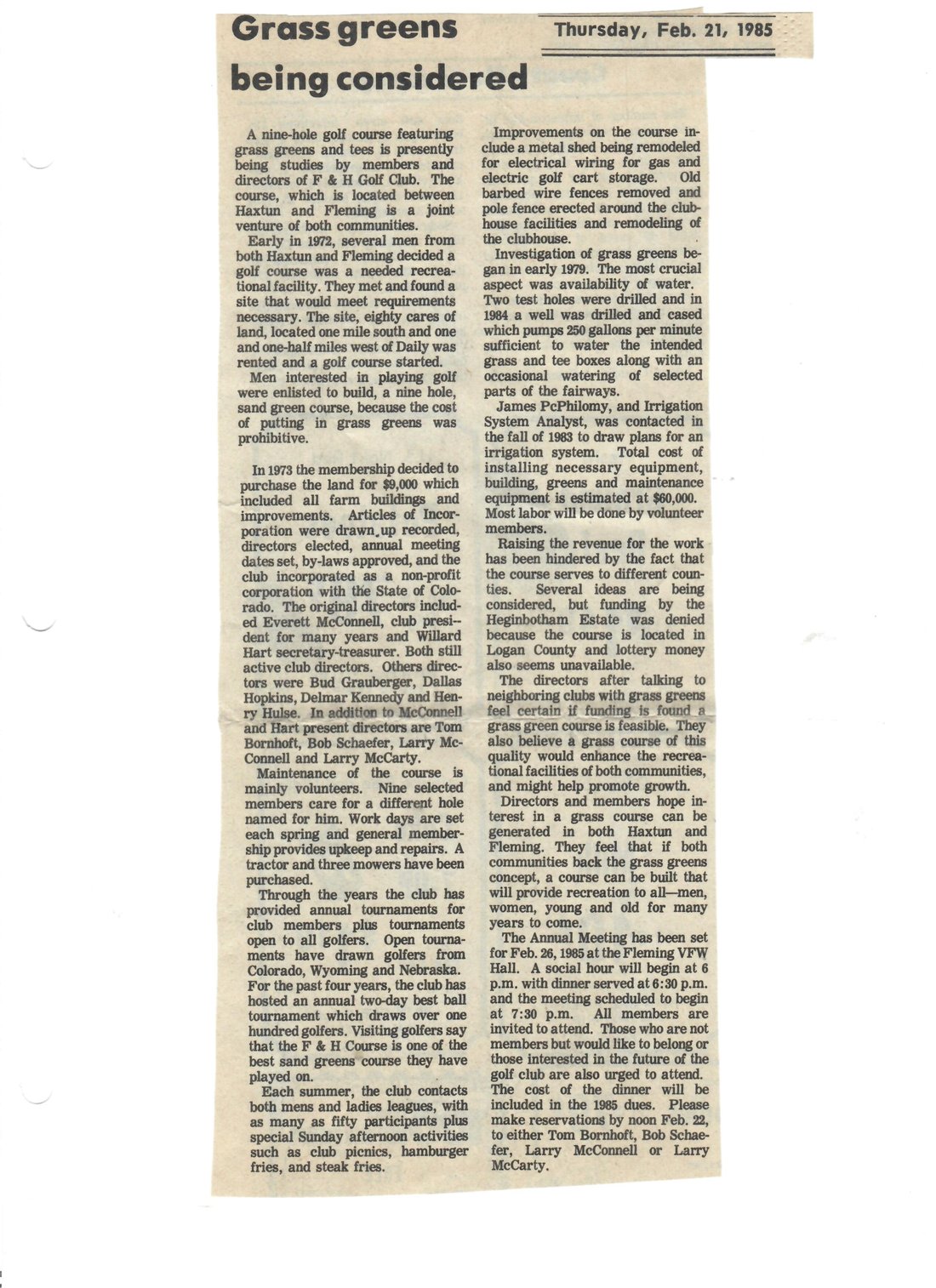
I HAD A DREAM! In April 1972, I contacted a farmer near Haxtun and he said he would lease us some ground for a golf course. He would meet Everett McConnell, Bud Grauberger, and myself in a restaurant and discuss a lease. Everett, Bud, and I sat down to three cups of coffee, but the farmer changed his mind, his land was not available. NOW THERE WERE THREE MEN WITH A DREAM!
Bud suggested we contact Virginia Parker from California who owned 80 acres of grassland south of Dailey. Bud contacted her and she agreed to lease this property to us for $400 per year.
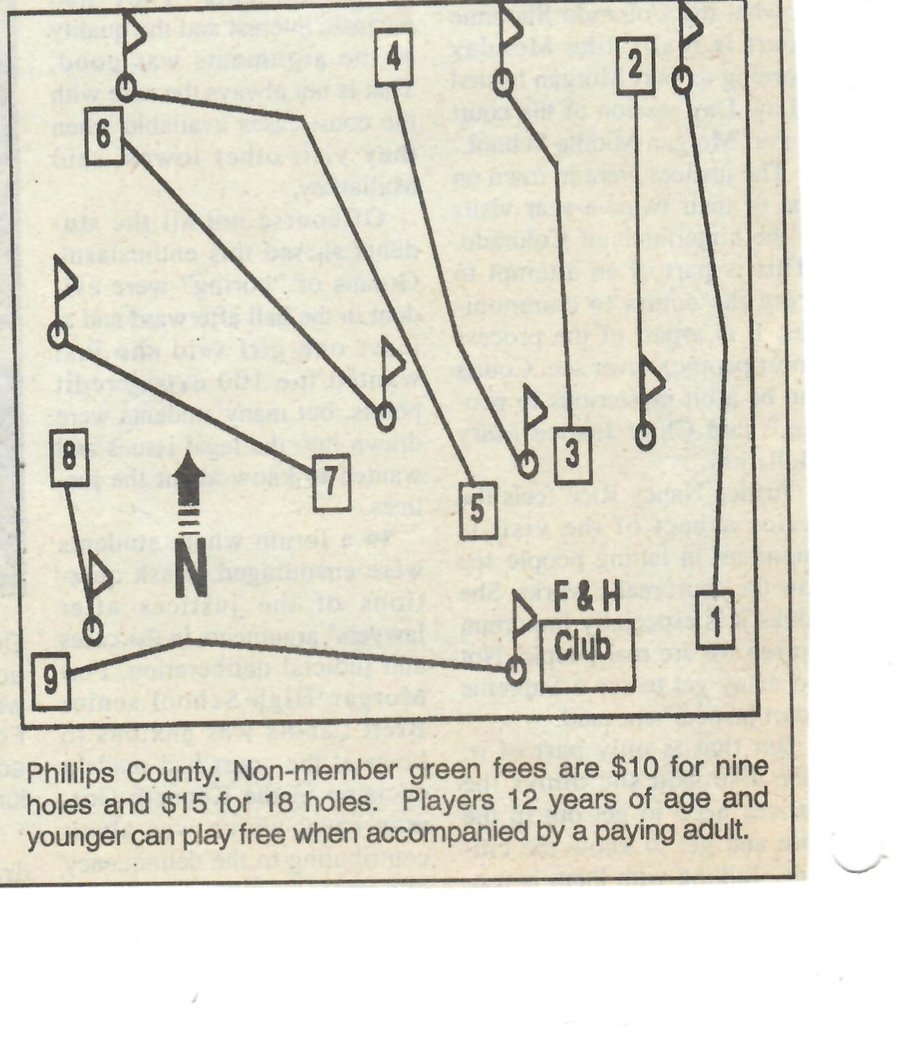
Back to the coffee shop again. We three added three more men, Henry Hulse, Delmar Kennedy, and Dallas Hopkins. NOW SIX MEN HAD A DREAM! All dreams cost money. We passed the hat and collected enough money for the rent and to build sand greens. Everett McConnell drew up the plans for the course. Everett, Dallas Hopkins, and John Spanger staked out the nine hole course.
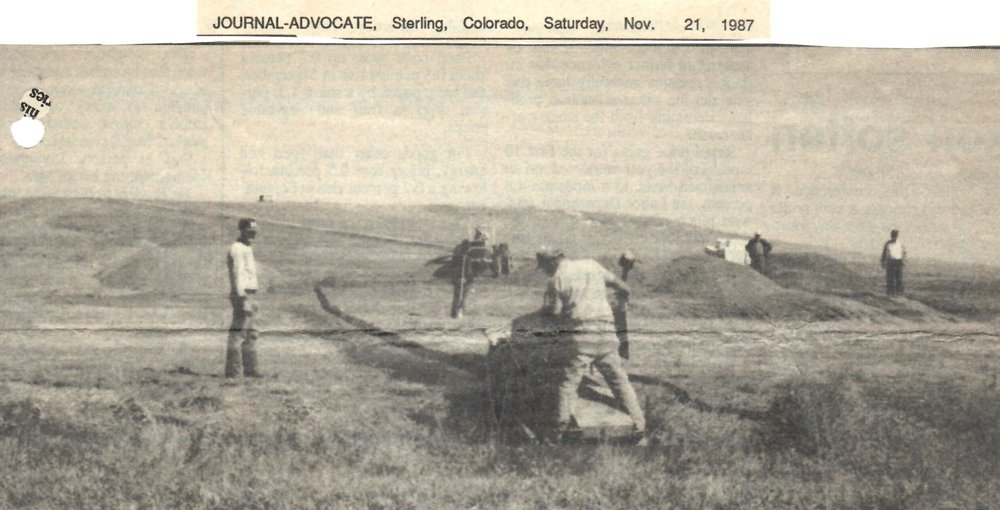
Ken Kurtzer loaned us a tractor and his brother, Gene, furnished the carryall. Now the fun begins. Cutting out a 30 foot circle in the native grass greens! I had to do number 7 over because I cut it in the wrong place. The tee boxes were made with strips of car tires wired together. They are still used as doormats.
We set a date to put the sand on the greens in May of 1972. Dallas Hopkins showed up with a cement mixer and a tank of drain oil that he had collected from several gas stations. Logan County Commissioners gave permission for the county workers to haul sand from Sterling to the golf course each night on their way home to Fleming after work. Our cost for the 90 yards of sand was $90.00. The rakes and levelers were built by Jack Kohnen. Men and women gathered one day for rock picking.
We borrowed an M & M tractor from Bud Grauberger and the town gave us a used brush mower. The course was highly contaminated with cow droppings, just tied a spike tooth harrow behind a pickup and scattered the cow pies out. (Made good fertilizer.) Several men took turns mowing the fairways, even Diz Garrett. Diz mowed where he played, the rough.
How did we get this paid for? Donations! A dollar here, dollar there, here a dollar, there a dollar, everywhere a dollar. The green fees the first year were $1.00 for 9 holes. Yearly membership fees were $25.00 per family. Total green fees collected the first year were $95.35. Total family members 40.
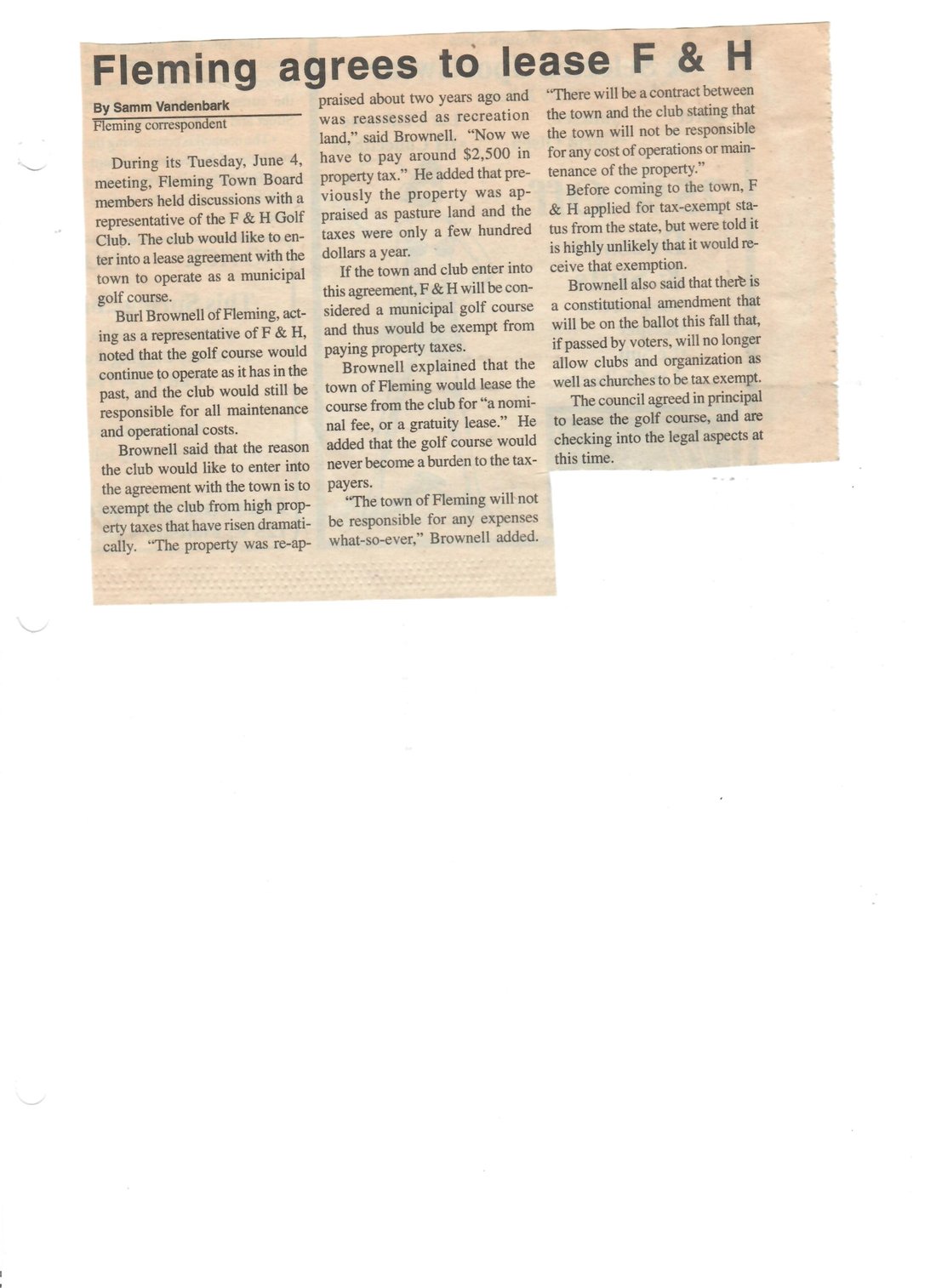
We are now out of debt after a year. Now let's purchase the property. We signed a contract March 5, 1973 for the 80 acres. Included were a two-story dwelling, a double granary, and a domestic well. Purchase price $9,000.00. $1,000.00 down & $2,000.00 due each June 1st until paid for. Rate of interest 7%.
Now I will try to enumerate all the changes that were made by DONATED LABOR. The granary was converted to a cart and tool shed. Ron and Scott Hart, Harold and Larry McConnell, Tom and Tommy Bornhoft, Verl Timm, and others worked several days on this project. We soon ran out of cart space so volunteers gathered again to build a leanto cart shed on the west side of the converted granary. This was done with all labor and materials, except the tin, donated by members. The next project was furnishing the house. The stove, refrigerator, couch, chairs, and kitchen utensiles were donated. Roger Lambert and Ron Hart wired the cart sheds. Plumbing, heating, some of the fixtures and labor were donated by Don Lock. A few years later, Bill Whittaker and others installed the roof and porch on the south side of the clubhouse. The rafters and perlings used were donated for this project.
One of our first sand green tournaments we had players come from four states. Now we're in the big times! School kids and women raked the sand greens for tips. $1.00 from the 'big' spenders. 1974 club tournament entry fee was $5.00. Men's first place prize was 9 golf balls, second place 6 golf balls, and third place 4 golf balls. Women's first place was 6 golf balls, second place was 4 golf balls, and third place was 2 golf balls. During several tournaments, Kyle McConnell and others picked up the range balls. Later we purchased a mechanical picker.
Before I go any further I should try to acknowledge all the people who have contributed to this project. We were really blessed with farmers willing to contribute their tractors, trucks, and equipment. Painters, carpenters, mechanics, businessmen, teachers, housewives, laborers, and many others. One lovely widow even persuaded a retired carpenter from California to come and live here, promising him that he could join in the fun by using his talents and labor for a worthwhile community project. The last I heard he is still having fun.
The house had five rooms on the main floor and two rooms upstairs. A winter project was to change the main floor. It was decided to knock out one wall to enlarge the south entry room, except Tom Bornhoft took a mighty swing with a sledge hammer. Through the wall it went. Sez he, 'Now there are two walls coming out.' Tom and Tommy Bornhoft, Harold and Larry McConnell, Ron Hart and Jerry Stiner took on the remodeling of the house. Adele McConnell showed up with the noon lunch. The main dish was kraut burgers. One man did not like sauerkraut. He described it as smelling like ----! The next day amidst the roars of laughter Adele presented the kraut hater with a special sandwich filled with hog fertilizer from Larry's pig pen. Adele you have my vote for the 'Queen of Laughter'. No problem to forgive your slip of tongue Jerry Stiner, even Adele does.
While I'm voting Jerry, I'll vote for you as the 'King of Volunteers'. Your carpenter skills show up on the driving range, signs, benches, the sign in station, kitchen cupboards, last winter's work on the shop, the house storage room, storage shed for the washer, and many other things. Thanks Jeanie for recruiting him. Thanks to Jim Atkin for sanding the floor and installing the carpet in the main rooms and tile in the two new bathrooms for the actual cost of the materials.
We needed new leathers on the well and a contractor advised us that the water was contaminated. To be sure of good water, we contracted a driller to drill a new house well. Lesson number 1, this area does not have a water pool under it. We drilled only 10 feet from the present well and there was no water bearing sand. Two volunteers showed up with their witching sticks. (Bud Kinzie and Bill Maddox.) Two test holes were drilled in the spot that they indicated. Ten feet of water bearing sand was found. The driller agreed to put 4' casing down and test pump it for $400.00. It pumped 25 gallons per minute. The water level did not go down any, which indicated that we hit an underground stream.
Now, in 1987, we began to have another DREAM. GRASS GREENS. We contacted a golf course consultant, Mr. McPhiline from Denver. He said he could design the green and we could water them with 20 gallons per minute. He didn't say how big they would be though. I asked him what was his main work. He answered, 'Correcting were mistakes that golf course designers make.' Some free advice he gave us, 'Don't make your course too tough! Make a fun course. You're not going to get any pros. People looking for fun will come.'
Two board members said, let's do it. One board member said no. One said we couldn't get our people to pay the green fees necessary for grass greens. Two board members said it's up to the members, let them decide. We called a meeting of the members and they agreed to make the dream come true.
Stewart Drilling Company submitted the lowest bid to drill the well and furnish the pump and controls. We obtained the specifications for the greens from Howard Trent Jones. The spec's called for 4 inches of fine 'plaster' sand and 8 inches of courser sand for a total of a 12 inch base. McAtee's bid to furnish the 4 inches of sand was $7,000.00. No we didn't have that kind of money.
Marty Johnson was contacted and looked over our course. He agreed to form the greens and tee boxes, furnish the peat moss, drainage tubing, and set the sprinklers for $20,000. He stated that he had built a course in Cambridge, Nebraska and used the total 12 inches of sand from the Republican River. I sent him a sample of the sand from a creek one half mile from our course. He said that would do. We hauled one thousand yards of sand for the 12-inch base on the 10 greens. Total cost of sand was $440. ($7,000 - $440 = $6,560 savings.)
Four of us, Tom and Tommy Bornhoft, Verl Timm and I bought a 5020 John Deere tractor and borrowed a carryall from the town of Haxtun. We started hauling dirt with this outfit in July and worked all through July and into August building number 4 green and some of the tee boxes. I was always glad when evenings and weekends came because either Ron or Verl would relieve me. My left leg was tired from kicking in the clutch. We ran that tractor over 1,000 hours.
An incident happened a few days later that showed these communities' spirit. A club member came to me and stated that he, his wife, his friend and wife did not come to the meeting. They were opposed to grass greens but they would do their part to help. Sure enough, Bud Kinzie showed up with his tractor and a borrowed carryall and hauled 750 loads of dirt for the greens and tee boxes.
Another incident. Sunday evening before we were to start on the greens, Lorin Starkebaum called and asked if he could help build the greens. Yes! Yes! He showed up the next day with a four-wheel drive tractor and a seven-yard carryall. He hauled dirt for four days and to this day I don't think he has even played one round of golf on this course. How's that for community spirit!
After our tournament, the third week in August of 1987, Bud Kinzie and Lorin Starkebaum arrived with their tractors and carryalls. Lorin worked three days and Bud hauled 760 loads of dirt. Trenching the ditches for the water lines, no haggling over the price. Tommy Bornhoft got hurt and could not drill Tom's wheat. If we would buy Tom a belt for his trencher and pay a man to drill his wheat, that would be his pay for digging the trenches. Our cost $287.00. Tom dug 27,000 feet of trenches. The going cost should have been $8,000. ($8,000 - $287 = $7,713 savings). Thank you Tom!
Jerry Williamson was the main chief in laying the pipe. The 'California Kid' was one of the many helpers. Also several men after their work hours would come out evenings and Saturdays and help lay pipe and enjoy the 'Happy Hour'.
When it came time to haul the sand, the town of Haxtun sent their pay loader with Wilbur Lightsey as the operator. It took three days to complete that job. Haxtun sent two dump trucks; Verl Timm was one of the drivers. Fleming sent one dump truck to help. Haxtun Coop elevator sent a truck with Dwain Whittaker as the driver. Other haulers were Bud Kinzie, Henry Dee, John McBride, Wilber Singleton, Harold McConnell, Vic Yost and others I haven't been able to recall. All joined in the fun, especially when the wives arrived with the delicious noon meals.
Some projects to pay for this golf course were: Harold McConnell raffled a golf cart. The winner was a golfer from Denver. He couldn't use the cart so Harold bought it. We cleared $5,400 on this project.
Another project was that individuals donated articles for an auction. We cleared some $3,200.00.
Plain old-fashioned solicitations was another method of raising money. 35 people contributed money. Only 24 were members. Contributions were from $50 to $2,000. Total contributions were $14,000.00. The group that always came from Denver to play in our 2 day tournament contributed their Calcutta winnings of $600 to buy trees.
So many members volunteered to help build the greens that Marty Johnson sent his worker home after he had only worked two days. The club borrowed $33,438 from the members to put in the grass greens. In 1988 after the grass greens were in, Verl Timm suggested a tournament for opening day. He sold entry fee tickets at $100 each for 18 holes of golf. Each golfer that paid the $100 received an individual trophy with their name and score card on it and a steak dinner that evening. He sold 80 entry tickets to people from Haxtun, Fleming, Sterling, Holyoke, and even Denver. Total $8,000. (A small jump from sand green fees of $5.00.)
The ladies prepared dinners for all the tournaments and gave the profits of $1,000 to $1,500 each year to pay for improvements on the clubhouse.
Grass greens now called for more carts. Art Wheeler's daughters, Janie & Linda donated a Quonset building from their farm for the club. A mover from Sterling wanted $4,000 to move this quonset to our property. Verl Timm said we wouldn't pay that kind of money. He just took his tools, climbed up on that building and took all the tin loose, numbered each piece and he and Joyce Burton used Burton's pickup and hauled it to the course. Tom Bornhoft and helpers used a long trailer, cut the frame in sections and hauled the frame to the course. He along with several happy workers set the building up. Don't leak nary a drop.
1989 project. Seed the fairways. I promised if they would put the fairway watering system in, that when I returned in the spring from Arizona I would personally do the seeding. Darn drill fell on me during the unloading from a trailer. I go to the hospital for 3 days. Major surgery on my shoulder. Well again here comes Bud Kinzie and Lowell Heath. By spending more time welding and repairing that darn drill than they did drilling, they finally completed this project.
Harold McConnell brought his tractor and the town's carryall. There were three places that the rocks croped out on the number 4 fairway. I sure enjoyed it when he would let me drive this new tractor. Just shift the lever to change gears. No leg pains. Hauled dirt from the fencerow and covered up the rocks. Made a beautiful fairway. The trees that you see now on the course were planted by the members early in the project. Also I think the Hofmeisters, Burtons, and the McConnells completed the fence. Of the thousands of hours of labor we only suffered one injury. Three days in the hospital for a shoulder operation. Thanks to Medicare all but $900 of the $16,500 was paid. Now the shoulder is just as good as new.
More cart space was needed the next year. The same crew gathered again and built a new shed on the east side of the quonset. Another project was putting in asphalt cart paths from the tee boxes to the fairways. Again Harold McConnell showed up with his tractor and the town's speed mover. Ron Hart remarked that he sure thought Harold's tractor was more fun to run than his dad's old two cylinder John Deere. Used the speed mover to dig and level paths for the asphalt. Several volunteers hauled dirt and leveled out the edges. Of the $8,000 cost for this project, all but $600 was donated by members. PS—have you noticed Harold's name sure shows up a lot? Thanks to Ralph Statz for building the fairway yardage markers. Each year the yardage becomes longer for me.
When we first visited with Marty Johnson, he estimated the cost for grass greens and fairways would be over $300,000. I understand that Enders Nebraska borrowed $200,000 from the government to put in their 9-hole golf course. Thanks to the donation of labor and materials, the total cost of our completed golf course was around $90,000.
To date, in August of 1999, there are 150 members, including family, single and junior memberships. Yearly dues for a 'family membership' is $250, 'singles' are $200 and 'juniors' are $50.
I'm sure that everyone who worked on this project will always be proud of this course. Friends pat yourself on your back for a job well done. This golf course will be enjoyed and taken care of for many years to come. I fail to remember all of the individuals that helped contribute to this fine project. I would be most happy to add all of your names and the projects you worked on, if you would just send me a note.
— Willard Hart, founder. Written June 2000.